11.02.2010

Wisconsin Labor: A Contemporary Portrait

Amber baking pizza, Manitowoc, 2007


Before the US economy imploded in the fall of 2008, the Wisconsin Arts Board in collaboration with the Wisconsin State Historical Society commissioned us to photograph "labor" in the state of Wisconsin. We had a sense that the frenetic 20th century consumer economy, high on endless credit and corporate buyouts, was obsolete. The sort of "industrial age" portrayals of labor in photographs that we had grown up with had lapsed into nostalgia as sterile chain restaurants and retail stores mushroomed along the Interstate of every small town we could think of. We were assigned our native region of northeastern Wisconsin. At first we assumed the largest employer in Manitowoc, where we live, would be one factory or another. Instead, it was a hospital with 1000+ employees. The business of taking care of aging factory works was big business. We proposed focusing on self-employed people or those carrying on family-owned businesses. They seemed iconoclasts in a time of increased homogenization working long hours without payoff so much as survival. We modeled our compositional approach after August Sander's People of the Twentieth Century, oft described as a "monumental lifelong project" of making portraits of social "types" around him in Germany. There seemed to be a connection between the fading traditions of pastrycooks, farmers and artists of Sander's era and the self-employed soda pop bottlers and bread bakers we found hidden away in Wisconsin. In 2008, we compiled these portraits plus many we made of farmers in a self-published book titled What We Do Here available online for $24.70.
August Samder. Pastrycook, 1928
Leah in her kitchen, Washington Island, 2007
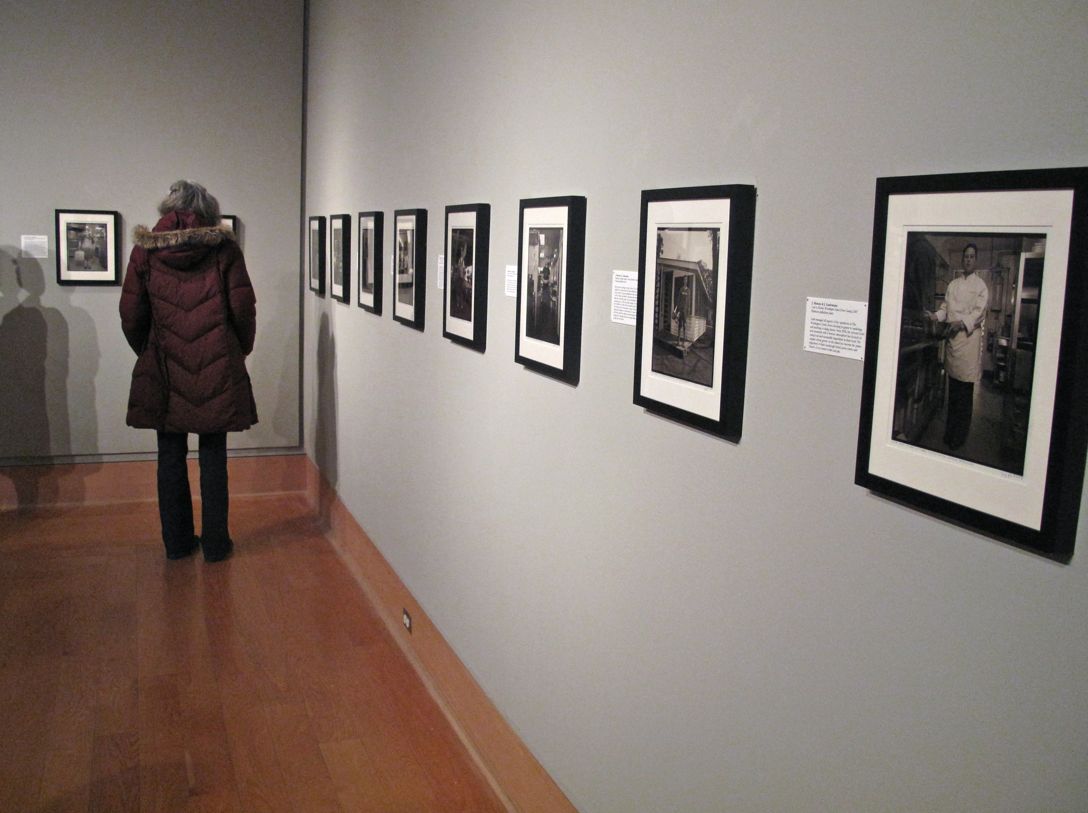
The James Watrous Gallery of the Wisconsin Academy has organized a traveling exhibition of the resulting photographs from the WAB project by us plus Tim Abler (prof at Cardinal Stritch University), Dick Blau (film prof at UW Milwaukee), David Herberlein (prof at UW River Falls) and Jamie Young (freelance photographer now living in Syacuse). The show opened on Friday, October 29 at the Wriston Art Center Galleries at Lawrence University where we are on faculty. For the project, we shot both 8x10 color transparency film and black-and-white negative film so produced platinum-palladium prints of our favorite negatives plus updated the project to include several earlier and more recent images plus a 23 minute film called "Charlie's in Kodachrome." The exhibition will travel to the Watrous Gallery in Madison in February and Cardinal Stritch University in fall 2011.

Visitors at Wriston Art Center Galleries. Photo by Leslie Walfish
Wriston Art Center Galleries installation November 2010

7.24.2010

Real Photo Postcard Survey @ Portrait Society

Visitor at Portrait Society Gallery - Photo © Art Elkon
After two years of effort, our Real Photo Postcard Survey opened on Gallery Night and Day at Portrait Society Gallery in Milwaukee on July 23. Milwaukee had been hit by torrential rains the day before adding an edge to the evening as heat and humidity soared. Still people were out in the streets and headed up five flights to the gallery. Art Elkon made photos throughout the evening and we made a video.
Visitors at  Portrait Society Gallery, July 2010
We put 160 palladium contact prints in four cherrywood display cases to show the chronology of their making and consider the human impulses to document, to collect, to communicate something of contemporary existence. The display cases are made by Penzoni Display in Michigan and marketed on eBay for the display of sports memorabilia. We re-purposed them. The small dark prints are demanding to look at and artist-friend Lindsay Lochman has suggested leaving magnifying glasses laying about the gallery to aid viewing. We may take her suggestion before the show ends on Saturday, October 2nd.
Installation view at Portrait Society Gallery, July 2010
A series of lifesize portraits from 8x10 transparencies made with an 11x14 Deardorff studio view camera came out of the project. The scale (72x28") emphasized the physicality of the body and the presentation of self. Scanned at high resolution and output on an Epson 9800 wide format inkjet printer on canvas, the portraits reference Rembrandt and Van Dyke paintings whose subjects were royals and the petite bourgeoisie. In 2010, we have photographed Amber D. who manages a Wendy's restaurant in Manitowoc, Thomas C., a self-proclaimed "recovering alcoholic", wrestling with the gravitas of his ancestry and Jo S., a retired psychiatric nurse. Many of the people in the photographs have intersected with us via the Midwestern art and music communities. For the most part, they are students, professors, writers, artists, curators, family, friends and neighbors.
Amber D. after a day at Wendy's at the opening
Gabriella S. and her mom Jill at the opening
Amber D. had a tough day at the Wendy's, but made the trip to Milwaukee to attend the opening still clad in her work uniform with a green badge promoting salads. Gabriella S. and her mother Jill brought bouquets of flowers and snapped pix. Many others we photographed attended too wearing the garb they were pictured in adding a "living sculpture" element to the evening.
Installation view at Portrait Society Gallery, Milwaukee, July 2010
Framed diptychs of found real photo postcard studio portraits from our collection juxtaposed with our palladium postcard portraits pointed toward our ongoing examination of and use of obsolete technologies and vernacular forms: postcards and the post office in the age of online social networking, analog photography in the age of digital imaging, the photographer's studio in the age of overvalued real estate and escalating foreclosures. Confined to our dark cave like studio for the past two years, the portraits have been taken out into the light with the exhibition.
Debra Brehmer signing catalogs - photo © Art Elkin
The gallery published a catalog/postcard set to document the project. We selected six portraits from the many we made to reproduce as postcards in the set. Two copies of each are included in a folio for a total of 12. Our hope is that the majority of the cards will be mailed out to extend the "mail art" portion of the project. It should be noted that the commissioned portrait participants received 100 postcards of themselves to mail out spinning off into projects onto themselves. The postcard set includes an essay about the project by gallerist, writer and art historian Debra Brehmer plus a grid of the 55 portraits commissioned through the Portrait Society Gallery in 2010. Catalogs are $10 each.
Installation view of Vanessa Winship's photographs, July 2010
Also on view at the Portrait Society Gallery is Vanessa Winship's Dancers and Fighters series of portraits of children in Georgia. The head-to-toe portraits provide a cultural contrast to our own portraits of Midwestern American people.

6.26.2010

Experiments in the Studio

Most of the palladium prints are made for the Real  Photo Postcard Survey Project. Our UV exposure unit broke down right after our film processor--thus reminding us of the extensive labor involved and how we depend on all of our art-making machines to work. Editing the prints has been ongoing for months with each portrait set out in a grid on top the flat files in the entryway of our studio as it is completed. Vintage postcard portraits keep turning up and are also set out. The Milwaukee Journal Sentinel covered the project while in process and that turned up a few commissions from people unknown to us thus expanding the scope. Liz Koerner from Wisconsin Public Television's "In Wisconsin" program also spent a day gathering material on the project for a segment to air in fall. We invited our Manitowoc neighbors Ryan and Richie to come by for a portrait that day.

We came upon wall-mounted specimen cases to display the prints and have been experimenting with background colors. We puzzled over how to install the prints for months (nail them to the wall in a grid? frame each individually? hang them in the standard plastic postcard holders?). Can small traditional hand-crafted prints have impact in a time when art often takes the form of grand spectacle (thinking Marina Abramovic @ MOMA or Urs Fischer excavating the floor of Gavin Brown). Our palladium prints are not much larger than an iPhone. They sit silently dark while everything streams and multitasks everywhere else. Face recognition is in the eyes of the beholder. The show opens on Gallery Night, Friday, July 23, 2010 at the Portrait Society Gallery in Milwaukee.

1.16.2010

Real Photo Postcard Survey Project


It's Winter in Wisconsin and people are coming to our studio to be made into postcards. Amber came by with a couple new dresses and the idea that she wanted to make a fashion statement.

12.29.2009

Herman (1920-2009)

Herman died last night (12.28.09) in a nursing home a week before his 90th birthday. We've been photographing him since 1986 and he was one of the four subjects of our One Million Years is Three Seconds film and book project. In 2006 we attended a funeral with him in St. Nazianz and a few years later went in search of the giant rocks he remembered from his childhood that were distributed along the fence line of his property. He wanted to find them again, to touch them, to sit on them, and was able to describe them in detail. He was living in senior housing in the Village of St. Nazianz and his old farmstead was slowly collapsing all the while he told township officials he would repair it soon. It was razed in November 2009. We've been working to add subtitles to One Million Years because the thick Germanic Wisconsin dialects of a couple of the men were somewhat difficult to decipher, especially with the low-fi sound recording methods we used. We were almost finished with Herman's section of the film when we heard the news of his passing.


12.18.2009

Aluminum Christmas Trees (1959-2009)

Most of the aluminum Christmas trees in existence were made by a company here in Manitowoc, Wisconsin. Thanks to the ingenuity of a few engineers and salesmen at Aluminum Specialty Company, the tree concept was sold and the first affordable, mass-produced aluminum trees were brought to market just in time for Christmas 1959. Up until the 1990s, there were hordes of the trees forgotten in the attics and garages of former employees. After the tree fad faded, the trees were more or less considered tacky. We thought the design was brilliant in its simplicity--a 7 foot tall tree collapsed neatly into a relatively small cardboard box printed with simple 2-color graphics. Branches were stored in kraft-paper sleeves for protection and easy insertion in the angled holes drilled in the wood dowel trunks covered in foil and held up by a folding tripod stand. The trees were cheap at rummages and thrifts so we bought enough to fill our storefront art gallery--an annual installation from 1993 to 1998. We studied the idiosyncrasies of their design: the way the foil was applied to the trunks or the cellophane tape to the rows of aluminum needles. Installed en masse in a stark white space, the trees formed an undulating mechanical ballet that was at once haunting and sublime. We made portraits of the individual trees with an 8x10 view camera on transparency film which required intense lighting tricks to define their presence. They reflected something poignant about the belief in newness and technology in the early 1960s that interested us (see video below). The photographs became Season's Gleamings: The Art of the Aluminum Christmas Tree thanks to editor David Brown at Melcher in New York. Designed by Helene Silverman, the first edition quickly sold out after the New York Times, CBS Sunday Morning and USA Today covered "the little pink book" as a prime holiday story at the end of 2004. The media coverage made Manitowoc take the tree story seriously. We met more people in the community who had helped market or make the trees as well as people all over the country who collected them and loved them in ways we could barely imagine. It seemed everyone had a tree story to tell. People showed us incredible snapshots from the 1960s or told us their holiday associations that ranged from childlike sweetness to punk-rock nihilism. Our interest in the trees as manufactured multiples and artifacts of a specific moment of small town innovation could not transcend the pull of straight-up holiday nostalgia. No subject matter we'd addressed before tapped into the emotionality that is Christmas. The burgeoning eBay data base made vintage Evergleam aluminum trees an easy and desirable item to buy and sell online and their value escalated. Trees that were once a dollar at rummage sales now sell for hundreds of dollars online. Pink aluminum trees (perhaps due to their iconic status as an arbiter of shameless American consumerism as in A Charlie Brown Christmas) became the holy grail and sold for as much as $2,000. We stored our trees away despite the popular demand to continue installing them in our gallery each holiday season. After experiencing the media treatment that framed us as "aluminum Christmas tree collectors", we fully comprehended that the trees--in their minimalist tree-ness--could not escape the intensity of Christmas and the media's insatiable desire for fresh holiday stories. We were anxious to pass the aluminum tree mantle to a public institution and that's when Joe Kapler, curator at the Wisconsin Historical Museum came along. He has taken on the responsibility of preserving the history of the Wisconsin-made Evergleam tree through the Museum's expanding collection and annual installations. After 5 years, Season's Gleamings will go out of print after having helped make the once neglected trees and their Wisconsin story museum-worthy.

12.09.2009

Trace @ The Project Lodge

Paul Baker Prindle and his students invited us to show some work in Trace: Wisconsin Portrait Makers at the Project Lodge in Madison. Tom Jones showed his enveloping and lush recent portraits of Native American fur trader era re-enactors (mind-bending), Alan Luft's black-and-white photographs were hung salon style blending portraits examining his German-American ancestry alongside portraits made in the streets of Berlin (gorgeous prints, carefully composed). A giant print by Prindle from his Mementi Mori series portrayed a site where a gay person had been murdered (sad and creepy). Jake Naughton, a journalism student branching out into art, showed color portraits of banal chairs (haunting yet colorful). We showed small inkjet prints from our What We Do Here project hung in a row by small clips. When we were undergrads at UW Madison in the early 1980s, we lived around the corner from the Project Lodge. The space was a womyns food coop then selling brown rice and herb tea. It felt comfortable to be in that place again and reminded us of all the bands, filmmakers, artists, zine people and record stores that used to and still seem to populate the neighborhood.