Robert "Fighting Bob" La Follette, Sr., 1922,
photographed by J. Lindemann's great uncle
John Glander at Glander Studio, Manitowoc, WI.
Wisconsin Historical Society.
By the time the Wisconsin Labor: A Contemporary Portrait exhibition opened on February 18, 2011 at the James Watrous Gallery in Madison, the political landscape had completely changed in Wisconsin and the nation. The Wisconsin State Journal covered the show and its uncanny timing and its focus on individual workers in the work place. Thousands of teachers, municipal works, moms, dads and kids had begun gathering at the state capitol building to protest the public union busting scheme of newly elected Scott Walker. Walker appeared to be the antithesis of everything about Wisconsin and the liberalism of people like "Fighting Bob" La Follette that many admired.
The Wisconsin Labor project was commissioned through a Wisconsin Arts Board Percent for the Arts grant in 2007 for the Wisconsin Department of Work Force Development building on East Washington Street in Madison. It's the place unemployed people go for help. Like us, most of the photographers were academics perhaps somewhat sheltered in the ivory tower. Dick Blau teaches at University of Wisconsin Milwaukee, Tim Abler at Cardinal Stritch College in Milwaukee, David Heberlein at University of Wisconsin River Falls and we at Lawrence University. Jamie Young left Madison after he finished work on the project for Syracuse, NY where he is a freelancer and his wife Harriet teaches at Syracuse University. The seven of us were selected by a panel of experts and work began on the project. Such a commission to photograph Wisconsin workers seemed a rare opportunity in 2007, a throw back to Roy Styker's Farm Securities Administration photo projects. We photographed throughout the summer and fall of 2007 and by the time our prints were made, framed and delivered in 2008, Barak Obama had been newly elected but the illusion of prosperity burst. Friends lost their jobs, real estate values tumbled and so did the value of stocks. The people we'd photographed experienced the downturn. The pizza place Amber worked at closed, Richie turned his liquor store into Wenzel's Perfect World, a night club because he couldn't compete with all the new franchise liquor stores, the yacht company laid off Dylan due to lack of sales of luxury yachts and so on. The exhibition opened first in Appleton in October 2010 to an ambivalent audience, but by the time it opened in Madison, the Wisconsin Arts Board's Percent For Arts Program that funded the project was on the verge of extinction and the capitol building was teeming with protesters spending days and nights rallying and inhabiting the capitol rotunda with hilarious signs expressing their views. We ran into friends handing out "Recall Scott Walker" bumper stickers and put one on our office door. It seemed the public once again cared about the lives of everyday people rather than the celebrities with ostentatious wealth displayed on high-def full color displays. Hummers and diamonds seemed vulgar and wasteful as they had during similarly challenging times during the Great Depression and World War II when the average person struggled just to get by. A selection of the photographs made for the project are housed at the Wisconsin State Historical Society in Madison. We presented a well-attended lecture on the photographs that influenced our approach to the Labor project on April 3 at the Watrous Gallery as documented by Martha Glowacki for the academy and Troy Freund on his blog.
"Imperial Walker," Madison Protests, February 18, 2011
Wisconsin Labor opening at Watrous Gallery, February 18, 2011
"Stop the Attack," Madison Protests, February 19, 2011
Lunch at Charlie's Place, Hortonville, WI, Summer 2010.
Kodachrome in the glovebox was not subjected to heat.
When small gauge film expert Toni Treadway of Brodsky & Treadway emailed with an offer of a few rolls of circa 1990s Kodachrome double 8 mm from her freezer, we knew what we'd do with it. While working on the Wisconsin Arts Board Wisconsin Labor Survey in 2007, we photographed a carhop named Elise at Charlie's Place in Hortonville. We wanted to make a short movie about the restaurant and the family that ran it. The owners were a brother and sister team who'd recently taken over from their retired dad who started it after buying an old A&W in 1965. Working together, they kept the place a viable summer business by orchestrating a self-described "shabby" Americana roadside atmosphere and offering up a selection of basic made-from-scratch food. The help of family-members and towns people was also essential. Patrons drink root beer floats out of frosted glasses (not styrofoam cups) and the sandwiches come wrapped in simple paper printed with the word "delicious" rather than the excess of multi-colored corporately-branded boxes. We filmed on classic car night during Elvis death week in August. Carl showed up with bedazzled white jumpsuit and an armful of polyester flower leis he distributed generously as he hugged babies and greeted carloads of customers. Wife Tori, dressed as Marilyn, served sheet cake from the hood of a white Cadillac. We finished shooting by September and shipped it off the exposed Kodachrome Dwayne's in Kansas to beat the processing rush. Not only had the last roll of Kodachrome been produced by Kodak, but K-14 processing was scheduled to cease December 30, 2010 at the family-owned lab in Kansas.
Being on TV is always odd and no less so last week when a Wisconsin Public Television segment on our Real Photo Postcard Survey Project aired. We heard of the solid air date through a newspaper reporter named Suzanne Weiss at the Herald-Times-Reporter. She'd received a press release and wrote a feature story on our project and the upcoming TV coverage.
Television is random as it beams into homes and places sometimes unanticipated. For example, we didn't get around to visiting our friend Nigel at Fox Lake Correctional as we usually do around the holidays. A fan of public media, he anticipated seeing us on TV. After the feature aired on January 6, he wrote us a hand-written letter critiquing our on-camera fashions:
It was fun to see you guys again...one of the early shots showed Johnie while the narrator babbled on and it appeared as though he was wearing a black scarf and I was like Oh no! Pretentious indoor artist scarf. But then later on I saw it was the black camera cloak. So obviously I was relieved...
We received other various responses including an email from a cordial woman named Judith who attached a digital snap capturing her profile. She was at a hockey game wearing wearing pink cat eye glasses and had a pointy chin. She wrote: "Julie...I think we could have been twins...ha ha...I am just 200 pounds larger."
When Liz Koerner (producer/director), Brad Wray (sound engineeer) and Mike Eicher (videographer) visited our studio in June to shoot the segment, we were finishing an intense string of portraits and palladium prints for a project to open in July at Portrait Society Gallery in Milwaukee. Our studio was cluttered with the stuff of unfinished works-in-progress, yet the crew found order and a visual story. They worked around the sporadic clattering of beer bottles being emptied from a dumpster at the bar across the street and the tangle of lights and cameras only leaving behind one quartz light and stand which we still need to return. We invited our longtime neighbors Ryan Ackley and Rich Bouril to come by for postcard portraits. Ryan owns the Boarding House, a skateboard shop, around the corner from our studio. We've known him since he was nine when we first moved into our studio. Richie owns the Culture Cafe across town and we share rural Wisconsin roots and buy his fresh-roasted coffee. We photographed the crew too.
Liz Koerner (producter/director) interviews John Shimon
in the midst of our cluttered Manitowoc studio while
Mike Eicher shoots video and Brad Wray records sound (6.17.10).
Assembling an Evergleam aluminum
Christmas tree, Season's Gleamings, 2004
Last week Franziska Felber called from Hamburg as part of her research on artificial Christmas trees. With our book Season's Gleamings: The Art of the Aluminum Christmas Treenow out of print, we didn't expect much interest in our tree story this year so were surprised. Franziska, a 27-year old journalist apprentice from Berlin, talked with us at length about aluminum tree history in Manitowoc. She ended up focusing on the history for her SPIEGEL ONLINE article titled Holy Tinsel published on Friday, December 17, 2010. It's written in German, which we could not read so my generous and kind cousin Phil Glander, a retired professor of German, provided a translation and we've posted it below. Judith Moriarty also wrote a piece about her memories of aluminum and other Christmas trees for Milwaukee's THIRD COAST DIGEST titled Once upon a time: A Tale of Christmas Trees Past published on December 10, 2010. Prompted by this journalistic interest in the trees, we checked online to see if copies of Season's Gleamings were still available only to find the prices fluctuating wildly from $10 to $100 per copy (original cover price was $16.95) everywhere from Amazon to Ebay. We decided to offer up a few signed copies with an 8x10 glossy inkjet "portrait" print of a gold Evergleam tree through our Etsy Store. We finally mustered up the energy to set up a single aluminum tree in the entryway of our studio. We're grateful the trees haven't been forgotten and that fans continue to surface. Last year, the Wisconsin Historical Society set up a spectacular and didactic exhibition of the trees which seemed their penultimate finest hour! We await their induction into a design exhibition at the Museum of Modern Art someday as their sleek geometry and "tree-in-a-box" concept are so stunning that we feel they truly deserve such a treatment.
P.S. 2012 Etsy design writer Jeni Sandberg revisited the trees for a new generation in her column published in December 2012 History Lesson: The Aluminum Christmas Tree. P.P.S. 2013 The Wisconsin Historical Museum in Madison set up an exhibition, 'Tis the Season, from November 26, 2013 to January 11, 2014 featuring the largest selection of Aluminum Special Aluminum trees ever. Articles touting the show have run in the LA Times Travel section by Mary Forgione, Milwaukee Journal Sentinel by Meg Jones, The Cap Times by Lindsay Christians and more.
Self-portrait in Neo-Post-Now Gallery, Manitowoc, Wisconsin,
with aluminum forest installation, December 1996
Holy Tinsel It was pink or gold and as tall as a man - but one thing it wasn't - real. In the 60s millions of Americans in the US set up an aluminum tree at Christmas time in their living room. The artificial tree became an emblem of the Space Age until a figure from the funny papers started its downfall.
By Franziska Felber English translation by Phil Glander
"Get the biggest aluminum Christmas tree you can find and paint it pink!" That's what Lucy, the little black- haired girl, told her comic strip friends, Charlie Brown and Linus, for the first time 45 years ago on American TV. In the "Peanuts" Christmas movie, A Charlie Brown Christmas, Lucy, like many Americans, had fallen for a Christmas fad - an artificial metal Christmas tree.
But what does Charlie Brown do? He ignores Lucy's orders and forgets about the shining pink. violet and red fake Christmas tree and gets the only real tree he can find instead: a crooked little tree which loses its needles at the slightest movement. Charlie disappoints Lucy, but his decision has far reaching consequences for the aluminum tree.
The animated film "A Charlie Brown Christmas" put an end to the biggest Christmas phenomenon of the 60s and gave it the coup de grace at the same time. At first the aluminum tree was so sought after in the USA that the Aluminum Specialty Company alone sold more than a million of the glittering trees with little metal curlicues. The tree fitted perfectly into the "Space Age" when artificial materials were the last word and every day technology the spirit of the age. But Charlie Brown's decision disrupted sales and people threw the colorful metal trees in the garbage. Finally production ended completely.
Manitowoc, Capital of the Aluminum Fad
The story of the aluminum tree, this shining Christmas phenomenon, was not yet over. The spurned fake trees celebrated a brilliant come back thirty years later.
Two photographers were the saviors of the tree. Julie Lindemann and John Shimon both come from a small city, Manitowoc, Wisconsin, which was the capital of the aluminum tree craze in the 60s. The trees were manufactured there and adorned not only living rooms. "In the space age there were these kitschy taverns with neon lights. At Christmas they had these aluminum trees behind the bar. I thought they were very
exotic. It was like they were from another planet." says photographer Lindemann recalling her first encounter with the fake trees.
The special feature of the trees from the Aluminum Specialty Company in Manitowoc was that the roughly hundred branches of a tree six feet tall all were the same length. They were stuck into various places on the trunk and formed the shape of a Christmas tree. The aluminum trees were featured at a toy fair in New York in 1959. In the 60s the model "Evergleam" became the bestseller of the company and sold like crazy in shining colors of silver, green gold and pink. Until Charlie Brown came along. In 1962 sales of the aluminum trees reached their peak, in 1967 they were scarcely in demand, and in 1969 they were removed from production.
Artificial Forest Causes a Sensation
When the Peanuts movie was shown on TV for the first time Julie Lindemann was only eight years old. But today she still believes that the end of the aluminum trees came with Charlie Brown. "The movie was shown every year and became a kind of fixture." So people wanted a real Christmas tree to decorate their living rooms instead of a colorful tinsel tree.
Lindemann who had seen her first aluminum tree in a tavern returned to her home town as a grown woman. Aluminum trees had been stuck in the attic and the garage for nearly thirty years by then. People watched Lindemann and her partner Shimon in disbelief when they decided in the 90s to collect the remaining trees and build a forest of them for the gallery they owned together.
The two photographers bought the trees for a dollar or so each, and nobody could believe that anyone at all was interested in the discarded kitschy giants. "We had to hear all the time about why anyone wanted to have junk like that." Lindemann says. In 1993 the collection had grown to about 40 trees, all of which Lindemann and Shimon decorated their gallery with. A painful experience for Lindemann because it took days for her to set up the trees. "In the end I was bleeding and crying. The branches are very sharp and they cut my hands and arms. But they were so beautiful that I forgot my pain when I was finished."
Christmas Among the Prototypes
The bigger their collection got, the more Lindemann became interested in the history of the trees. But no matter whom she asked, nobody could remember Manitowoc's days as capital of kitsch. Yet here the "Evergleam" was manufactured - the most popular aluminum tree in the US. Finally chance came to Lindemann's rescue on a winter day in 1996. Shortly before Christmas she was in the gallery. Outside it was icy cold, inside the trees were lighted. Some were revolving every minute and making a slight rustling sound. The doorbell rang. An elderly couple stood in the cold, asked to come in and walked through the shining forest. The man looked around and said, "I designed these trees."
The man in the forest was Richard Thomsen, former chief engineer for the Aluminum Specialty Co., a large manufactured of aluminum cooking untensils. An expert in mass production, in 1958 Thomsen was given the task of copying a hand made aluminum Christmas tree seen in Chicago and getting it ready for mass production - as quick as he could. Thomsen did just that with the help of two colleagues. Since then he had spent every Christmas under a silver colored prototype nearly nine feet tall. When he met the two artists he was touched to see that his achievement had finally been acknowledged.
The local press soon became interested in the forest in Lindemann's gallery- and so were the residents of Manitowoc. They were proud again of the rejected product of their city. Many did the same thing Thomsen did, they came in the gallery and told of their past with "Aluminum Specialty." Some took out their "Evergleam" boxes out, set the glittering giants in living rooms and store windows and thus began the shining renaissance of the aluminum Christmas tree. But after Lindemann and Shimon erected their winter forest five years in a row they'd had enough. They exhibited their trees for the last time in 1998.
Trees on Ebay
Before they packed them away for the last time they took pictures of their favorite trees and made a picture book of them. It appeared in 2004 under the title "Season's Gleamings." Lindemann and Shimon gave some intereviews but they didn't count on what happened next. The biggest American media came to Manitowoc to tell the story of the home of the aluminum trees. They called Manitowoc "Tinsel Town." "We didn't know how powerful Christmas was for the media," Lindemann says.
But they were happy about the attention the city received. "In the US small towns have a bad image. They look real small against the glamour of Hollywood and this whole marketed life style. But suddenly here was something people could be proud of." Glamour was back in Manitowoc. And trees which once could be bought at garage sales for a dollar now were going for a hundred times as much. In 2005 an especially rare pink colored aluminum tree went for the record sum of 2600 Euros on the internet.
# # #
P.S. One of our favorite aluminum Christmas tree stories was by Rachel Manek for Fox 11 TV in Green Bay from 2004. In the space of a day, the reporter and her crew of one interviewed key people throughout Manitowoc County to tell the tree story. The fantastical CBS Sunday Morning crew and Russ Mitchell had already visited Manitowoc by then and we've posted that piece below too. In addition, various bloggers white about Season's Gleamings time and again.
As part of an experiment for our Digital Processes course at Lawrence University, we set up an Etsy store to sell small items we make in our studio. We wanted to understand how it worked and wondered if our studio art students would find it useful. Kristin Boehm, a former student, has been selling her cool knitted technology cases for several years under the name Spinhandspundesigns and other friends had told us of their Etsy successes. We put together DVDs of our rarely screened films, our out-of-print book Season's Gleamings and a series of cyanotype postcards of Lake Michigan and opened our store last week. We sold 26 individual items in the first few days and are getting to know our helpful postal staffers much better. The scale and intimacy of Etsy reminded us the early 1980s when we'd make cassettes of our band's music (packaged with miscellaneous objects we'd get cheap at thrift stores or the Kresege's in baggies) and zines with hand-silk screened covers to sell at record stores, shows and on the Library Mall in Madison as students at the UW. The immediacy and lack of censorship of the objects was a thrill and seems parallel in many ways to selling art on Etsy sans the pink hair and Aqua Net.
Changed Perspectives exhibition installation @ JM Kohler Arts Center, Sheboygan, WI, December 2010
Surivor Janine Bergeron's digital photos with listening station
@ JM Kohler Arts Center, Sheboygan, WI, December 2010
Our collaborative project with the John Michael Kohler Arts Center in nearby Sheboygan, Wisconsin, resulted in an exhibition titled Changed Perspectives. It explores the world view of a dozen cancer survivors forever altered by their experience with the c-word. Yvonne Montoya, Amy Horst and the Kohler staff designed the installation to include shadow box assemblages of the snapshot size prints by the survivor/participants whose subject matter ranged from intensely colorful flowers and trees to ethereal lake, cloud and land-scapes as well as portraits of family and friends. The images had meaning to the individual who made the image way beyond what could be read using the standard art methods which are most often based on formal elements rather than narrative. Listening stations positioned throughout the gallery enable viewers to hear each survivor/participant reflect, in their own words, on their cancer experience and their photos. We made portraits of six of the participating survivors, which are also on display. The show was scheduled to open with a reception and program on December 12, 2010. The Sheboygan Press had even written a preview! Unfortunately, a record-breaking blizzard forced the Kohler Arts Center to close for the first time in five years! The event which was to include a program and refreshments and has been rescheduled for January 20, 2011, 6-8 pm. The show received a brief mention in the Chicago Tribune, an extensive rumination by Domenica Schiro on examiner.comand a review in the Shepherd Express.
When we viewed the show after the blizzard cleared, one of the Kohler security guards recognized us and asked if we had had cancer. Her husband died of cancer 10 years ago and she still felt changed by the experience and found the exhibition bringing back memories and issues. Our experience with cancer was through our mothers. John's mother had been an American Cancer Society volunteer for decades delivering wigs and medical supplies to cancer patients throughout Manitowoc County. Julie's mother had cancer, but did not survive.
When the doctor enters the examining room and orders more tests, everything feels and looks different. Hearing the surgeon say "your mom has a very very bad cancer" that January day in 2007 instantly changed our daily routine. From that moment on, our days included accompanying mom to her appointments for radiation, Chemo, blood tests, CT scans, banana-flavored Barium shakes and the world of DPOA and DNR forms. The news of the cancer came as a shock--there had been little warning. When mom heard the diagnosis she whispered, "I don't have that." But she did and in less than a year's time she was gone.
The following summer, the Kohler invited us for a residency to collaborate on a digital photography project scheduled for the fall of 2010. It would be for cancer survivors in the community who had wanted more art in their lives as part of an ambitious program called Connecting Communities funded through the National Endowment for the Arts. The Kohler has marvelous gallery spaces and an inspiring and always excellent artistic vision rare for a small Midwestern city. With the help of the Sheboygan County Cancer Care Fund and Tim Renzelman (a survivor himself) participants were gathered.
At our first meeting in late August 2010, we gave a slide talk in the Kohler's beautiful auditorium declaring "You are an artist!" and invited surivors to collaborate with us on a project "to make photos reflecting your view of life." The images would be exhibited at the Kohler along with our photographs in December. We showed participants examples of our portrait photographs as well as work by artist/cancer survivors Corinne Day, the fashion photographer who died just days later from her brain tumor and whose bookDiaryreflected her cancer experience though self-portraits in the hospital, Jo Spence whose breast cancer turned her from artist to heath-care activist and photo-therapist, and Ralph Eugene Meatyard whose cancer inspired hisFamily Album of LucyBelle Craterseries of portraits of his friends wearing grotesque masks.
Survivorship: Through the Lens workshop in the JM Kohler Arts Center Breezeway, 10.30.2010
The Kohler's staff and volunteers worked further with participants to help them use their digital cameras and post images to flickr and the Surivorship: Through the Lens group that had been established. We studied the images as participants posted them then chose six people to photograph. We based our choices of location and content on the images we studied on flickr. The survivors had been scanned, probed, poked, tested and surgically altered during their cancer treatments and they stood bravely before our static and slow 8x10 view camera on its wooden tripod. We felt a sense of gravity as we worked with each person to capture them on film and produce as monumental size print (50x40") as we could given our resources.
Photographing Vicki in the park 9.25.2010
Vicki standing in yoga pose in environmental park, Sheboygan, Wisconsin, 2010
9.25.2010 - Vicki took walks in the park regularly and had completed her Master's thesis on the breeding bird communities in the nearby floodplain. She posted haunting images of the park on flickrwhich she wrote eloquently about. Since her cancer diagnosis and treatment, she found even more comfort in the park. We talked about her practice of T'ai Chi and yoga, which she teaches to other cancer survivors. “If one can fix one's gaze on the light at the end of the tunnel, treatment can be endured.”
Photographing Tammy at her mom's house 10.10.2010
Tammy (middle) with her sisters Kathy (L) and Debbie (R) at their mother's condo during a Sunday Packer game, Sheboygan, Wisconsin, 2010
10.10.2010 - Tammy and her two sisters gathered at their mom's new condo for the Sunday afternoon Packer game. Their father had passed away from cancer a few years ago and knowing their grandmother had breast cancer, the sisters underwent genetic testing only to discover all three carried the BRCA2 gene. Four years ago Tammy's diagnosis was Stage II and was treated successfully. Then her younger sister was diagnosed with Stage 1 and her youngest sister was clear. "Cancer is a nasty thing" their mom told us. “You realize life is short—you appreciate the people around you,” Tammy added. Tammy posted whimsical almost humorous pictures of toads and garden ornaments onflickrand one portrait of her with her mom and sister taken when they gathered together to watch the Packer game at her mom's new condo. It struck us because it reflected the warmth and closeness the women shared increasingly since sharing their multiple cancer experiences.
Photographing Joanne in her backyard 10.10.2010
Joanne in her garden, Sheboygan, Wisconsin, 2010
10.10.2010 - Joanne collaborated with her husband to design and maintain their backyard garden, which felt like a sanctuary. She was so involved in her volunteer work that she paid little attention to her symptoms. When finally diagnosed with Stage III cancer 4-1/2 years ago, she underwent intensive chemo and survived it. She kept a journal written in elegant script and illustrated with color snapshots mapping her experiences including a head shaving party during chemo. “You’re thankful for what you’ve got. It can all be gone pretty quickly,” she said. For the Kohler project, she concentrated on photographing hands and feet and posted them on flickr. "I am also a 38 year Rheumatoid Arthritis survivor after being diagnosed at the age of 19," she wrote. "My deformed hands (and feet) are as much a part of me as is any other part of my body. People often comment to me how surprised they are at all I am able to accomplish with these twisted, gnarled hands."
Photographing Dave at Matthews Oncology, 10.14.2010
Dave in cancer clinic waiting room, Sheboygan, Wisconsin, 2010
10.14.2010 - Dave met us in the waiting room at the cancer clinic, which had been newly remodeled. He had spent a great deal of time sitting there before treatments 10 years ago. "I'm still here and some of them aren't," he said of the people he'd met. While waiting he said he'd close his eyes, tip back his head and think, "I'll go somewhere else." Getting cancer was a life-changing event but, "I can't say I really notice the sunsets more now. I noticed them before and I liked them. I didn't have to get cancer to notice them." We were struck by his "treatment buildings" images posted on flickr so decided to photograph him there.
Photographing Dr. Corrigan at the Prevea Clinic, Plymouth, WI, 10.22.2010
Dr. Corrigan in procedure room decorated with his framed photograph, Plymouth, Wisconsin, 2010
10.22.2010 - Dr. Corrigan’s framed color photographs were displayed around the sleek new clinic housing his practice in Plymouth. He self-diagnosed his cancer in 2006 at age 42 then began photographing and writing poetry during his treatment and recovery. “Photography just kind of opened my eyes,” he wrote recently. Struck by the intensity of a medical professional knowing that something was wrong but having to endure the protocol of treatment having a deeper knowledge of the implications struck us. We decided to photograph him at the new clinic where both his profession and avocation could be visible. His images posted on flickr are lush and sometimes haunting studies of trees and some of them are framed and on display at the clinic. He photographed the the participants at one of our workshops and posted them too.
Photographing Lucy at home 11.5.2010
Lucy with her snapshots, Sheboygan, Wisconsin, 2010
11.5.2010 - Lucy’s brother called her Lulu. He died of cancer more than 50 years ago. She found his memory comforting when she was diagnosed with cancer herself two years ago. She recounted his "journey with cancer" while showing us her old snapshots, which she stored in neat envelops in a box covered in floral fabric. JMKAC staff and volunteers scanned and uploaded the snapshots to flickr. “Looking back at these pictures brings tears, happy tears. In my mind, it was like my brother was here.” We made a video of Lucy telling his story which will be included in the exhibition.
P.S. While in Sheboygan after our meetings, workshops and photo sessions, we revisited our favorite eateries including Schultz's and Jume's (with their mid-century lunch counters) as well as checking out more contemporary dining spots such as Field to Fork and the Kohler's own cafe. We hadn't strolled the boardwalk in many years so checked it out on a Sunday afternoon and later found Toy's Grocery on the north side of town on the way back to Manitowoc and stocked up on olive oil, rice, soy sauce, sandalwood soap and Serbian jam!
Before the US economy imploded in the fall of 2008, the Wisconsin Arts Board in collaboration with the Wisconsin State Historical Society commissioned us to photograph "labor" in the state of Wisconsin. We had a sense that the frenetic 20th century consumer economy, high on endless credit and corporate buyouts, was obsolete. The sort of "industrial age" portrayals of labor in photographs that we had grown up with had lapsed into nostalgia as sterile chain restaurants and retail stores mushroomed along the Interstate of every small town we could think of. We were assigned our native region of northeastern Wisconsin. At first we assumed the largest employer in Manitowoc, where we live, would be one factory or another. Instead, it was a hospital with 1000+ employees. The business of taking care of aging factory works was big business. We proposed focusing on self-employed people or those carrying on family-owned businesses. They seemed iconoclasts in a time of increased homogenization working long hours without payoff so much as survival. We modeled our compositional approach after August Sander'sPeople of the Twentieth Century, oft described as a "monumental lifelong project" of making portraits of social "types" around him in Germany. There seemed to be a connection between the fading traditions of pastrycooks, farmers and artists of Sander's era and the self-employed soda pop bottlers and bread bakers we found hidden away in Wisconsin. In 2008, we compiled these portraits plus many we made of farmers in a self-published book titled What We Do Here available online for $24.70.
August Samder. Pastrycook, 1928
Leah in her kitchen, Washington Island, 2007
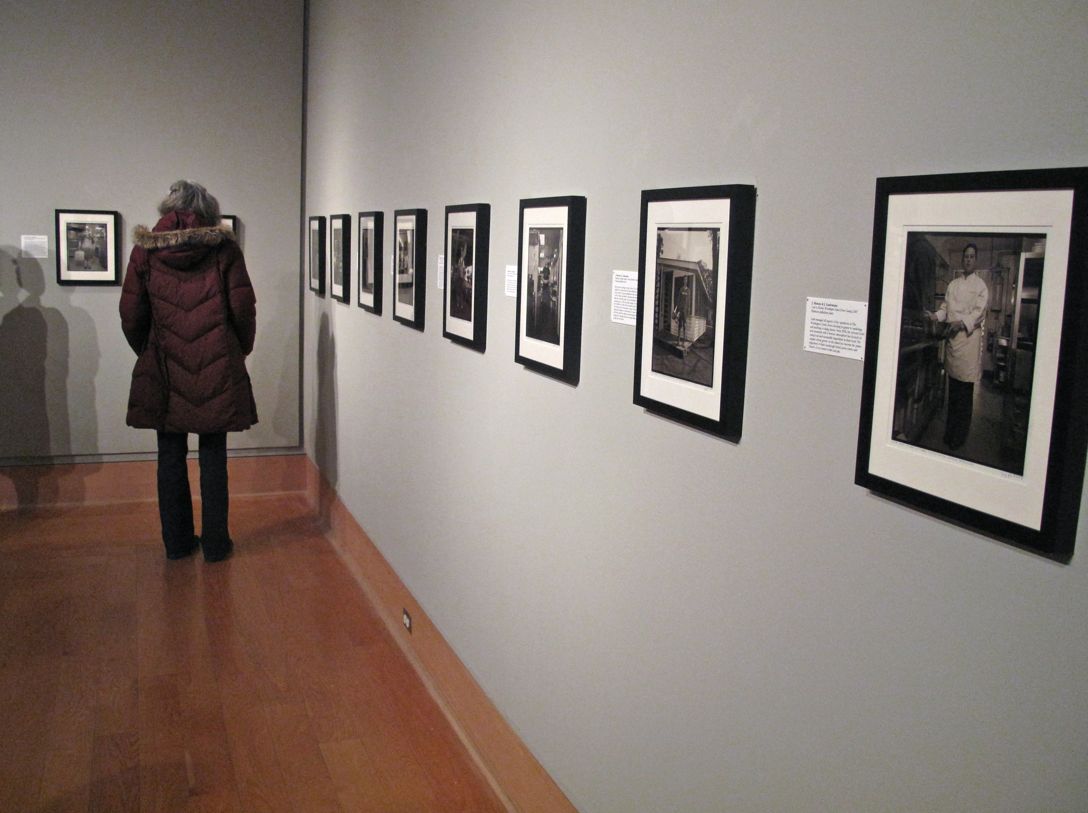
The James Watrous Gallery of the Wisconsin Academy has organized a traveling exhibition of the resulting photographs from the WAB project by us plus Tim Abler (prof at Cardinal Stritch University), Dick Blau (film prof at UW Milwaukee), David Herberlein (prof at UW River Falls) and Jamie Young (freelance photographer now living in Syacuse). The show opened on Friday, October 29 at the Wriston Art Center Galleries at Lawrence University where we are on faculty. For the project, we shot both 8x10 color transparency film and black-and-white negative film so produced platinum-palladium prints of our favorite negatives plus updated the project to include several earlier and more recent images plus a 23 minute film called "Charlie's in Kodachrome." The exhibition will travel to the Watrous Gallery in Madison in February and Cardinal Stritch University in fall 2011.
Visitors at Wriston Art Center Galleries. Photo by Leslie Walfish
Wriston Art Center Galleries installation November 2010